

Production capacity is one of the first factors manufacturers consider when evaluating a ventilation duct machine, but the machine's rated speed alone does not tell the whole story. Two machines may have similar maximum working speeds while producing very different amounts of finished ductwork in an actual workshop.
The difference usually comes from machine configuration, processing steps, material utilization, operator involvement, and how consistently the equipment can run. A machine that moves quickly but requires frequent adjustments or manual intervention may deliver less practical output than a well-integrated automated system running at a stable speed.
For manufacturers planning to increase duct production, it is therefore more useful to look at capacity as the result of the entire fabrication process. The following factors help explain what really determines the output of a ventilation duct machine.
Not every ventilation duct machine performs the same number of fabrication operations. The configuration of the equipment directly affects how much work can be completed automatically and how much material must move between separate machines.
A basic production setup may include individual machines for cutting, beading, lock forming, flange forming, and folding. Each machine can perform its own operation efficiently, but transferring sheets from one process to another introduces additional handling time.
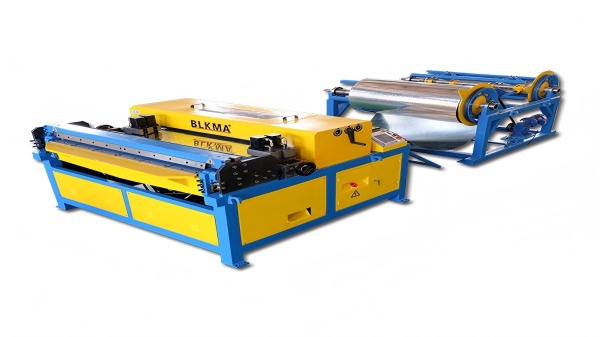
By comparison, an automated duct production line can combine several processes into a continuous workflow. BLKMA, for example, offers different automatic duct production line configurations depending on the required processing sequence. Its Line 3 integrates decoiling, leveling and grooving, notching, cutting, and bending, while Line 5 adds processes such as lock forming, flange forming, and folding.
This means machine configuration should be evaluated according to the type of ductwork being produced. A simpler configuration may be sufficient for a workshop with limited production requirements, while a more integrated line can make better sense when the manufacturer handles large volumes or many repeated duct specifications.
Manufacturers can review different duct production machines and automated fabrication solutions to compare configurations before deciding which level of automation fits their production workflow.
Production capacity is closely related to how long it takes to complete each duct component. The faster a material can move through the required operations without unnecessary stops, the greater the potential output.
For example, a production line may need to level a coil, create beads or grooves, notch corners, cut individual pieces, form locks, create flanges, and fold the sheet. If these operations are performed sequentially with significant manual handling between them, the total cycle time can increase even when individual machines operate at relatively high speeds.
An automated ventilation duct machine reduces this problem by coordinating multiple processes within one production system. CNC control can determine cutting positions, dimensions, and processing sequences from programmed production data, allowing the machine to move from one operation to the next with less manual intervention.
BLKMA's published specifications illustrate why maximum working speed should be considered alongside the complete process. For example, its Line 3 models have a maximum working speed of 15 m/min, while the Line 5 models are also specified at up to 15 m/min. However, the additional operations integrated into Line 5 can significantly change what the machine accomplishes during a production cycle.
In practical terms, manufacturers should therefore ask not only, "How fast does the machine run?" but also, "How many fabrication steps can it complete during that operating time?"
Production capacity is not simply a matter of producing more pieces. Material utilization also determines how efficiently a machine converts sheet metal into finished ductwork.
When cutting layouts generate unnecessary scrap, the effective value of each production cycle decreases. Poor material utilization can also increase the number of coil changes, handling operations, and adjustments required during production.
Modern automated duct lines can address part of this issue through optimized feeding and cutting functions. BLKMA's Auto Duct Production Line 5, for instance, includes a material-saving mode designed to keep waste below 20 mm per roll under the conditions specified by the manufacturer.
This type of function can be particularly useful when production involves many different duct dimensions. Instead of treating each sheet as an isolated piece, the control system can organize production data and cutting requirements to make more effective use of the available coil material.
Material efficiency also affects production planning. If more usable duct components can be obtained from the same coil, manufacturers may reduce material waste while maintaining a similar production schedule. As a result, a machine with good material utilization can contribute to overall manufacturing efficiency even when its nominal operating speed is unchanged.
Automation does not necessarily mean that a production line can operate without people. The more important question is how much operator time is required for routine production activities.
With conventional fabrication equipment, operators may need to measure sheets, position material, transfer workpieces, adjust machine settings, and move components between different processing stations. These activities may seem small individually, but their combined effect becomes significant over a full production shift.
An automated ventilation duct machine can reduce some of these repetitive tasks by coordinating material feeding, positioning, cutting, and forming through CNC control. This allows operators to focus more on production supervision, material preparation, quality checks, and handling activities that cannot be eliminated completely.
However, operator requirements still vary by machine configuration. BLKMA's standard Auto Duct Production Line 5, for example, specifies a minimum of one operator. That does not mean staffing requirements are identical for every factory. Material loading, finished duct handling, production volume, and workflow organization can all affect the actual labor requirement.
For this reason, manufacturers should calculate capacity based on the entire production team and workflow rather than assuming that a higher automation level automatically means zero labor.
A machine's theoretical capacity only becomes meaningful when the equipment can maintain stable operation throughout production.
Frequent interruptions can reduce actual output even when the machine has a high rated speed. Problems such as material misalignment, incorrect positioning, tool wear, programming errors, or repeated manual adjustments can create small delays that accumulate over an entire shift.
Machine construction and component selection therefore have a direct relationship with production stability. BLKMA's automated duct production lines use components such as Mitsubishi CNC systems, Omron encoders, Hiwin linear guideways, Schneider electrical components, and Festo pneumatic components on specified configurations.
The purpose of these components is not simply to make the machine look more advanced. Stable control, accurate positioning, and reliable movement help the production line repeat programmed operations consistently.
Maintenance is equally important. Even a well-designed ventilation duct machine requires regular inspection and appropriate adjustment. Keeping feeding systems, cutting tools, forming components, sensors, and other critical parts in suitable working condition helps reduce avoidable production interruptions.
Rated speed provides a useful reference, but it should not be treated as the final measure of production capacity. Actual output depends on how efficiently the machine converts operating time into completed duct components.
BLKMA provides a useful example of why capacity needs to be assessed by machine configuration. Its standard Auto Duct Production Line 5 is published with a daily processing capability of approximately 600–2,000 square meters per shift, while the U-shape Auto Duct Production Line 5 is specified at approximately 1,000–2,500 square meters per day. These figures are manufacturer-published specifications for the respective configurations and should not be interpreted as universal output for every production environment.
Actual output can vary according to duct dimensions, material thickness, production mix, machine setup, operating conditions, and workflow organization. A manufacturer producing a high proportion of small, repetitive duct sections may achieve a different result from a factory producing large or frequently changing specifications.
It is also important to distinguish a rigid sheet-metal duct production system from a flexible duct machine. Flexible duct equipment is designed around different materials, forming methods, and production requirements, so its capacity should not be compared directly with an automated sheet-metal duct line simply by looking at nominal speed.
| Capacity Factor | What It Indicates | Why It Matters |
|---|---|---|
| Machine configuration | Number and type of integrated operations | Determines how much work can be completed in one production flow |
| Working speed | Maximum material feeding or processing speed | Provides a reference for potential production performance |
| Cycle time | Time required to complete each processing sequence | Directly affects the number of components produced over time |
| Material utilization | How effectively sheet metal is converted into finished parts | Influences waste, coil usage, and production efficiency |
| Operator involvement | Amount of manual handling and supervision required | Can influence actual throughput and labor requirements |
| Machine stability | Ability to maintain consistent operation | Reduces downtime and interruptions during production |
The production capacity of a ventilation duct machine is determined by much more than its maximum working speed. Machine configuration, integrated processing steps, cycle time, material utilization, operator involvement, and operational stability all influence how much finished ductwork a production system can deliver.
For manufacturers comparing equipment, the most useful approach is to evaluate the complete production workflow. A machine that integrates more processes, minimizes unnecessary handling, uses material efficiently, and maintains stable operation can provide greater practical productivity than a machine selected simply because it has a higher nominal speed.
The right configuration ultimately depends on production volume, duct specifications, material requirements, available labor, and the level of automation required. If you are comparing different duct production configurations or planning to expand your fabrication capacity, you can discuss your duct production requirements with BLKMA's technical team to determine which machine configuration is more suitable for your application.
There is no single factor. Machine configuration, processing speed, cycle time, material utilization, operator involvement, and machine stability all contribute to actual production capacity.
No. Working speed is only one part of the calculation. If the machine requires frequent manual handling or stops between processes, actual output may be lower than expected from its rated speed.
Automation can connect several fabrication operations and reduce repetitive material handling. CNC control also helps coordinate cutting, positioning, and forming according to programmed production data.
Better material utilization reduces unnecessary scrap and can help manufacturers produce more usable components from each coil. It can also reduce material changes and unnecessary handling during production.
The requirement depends on the machine configuration and factory workflow. For example, BLKMA's standard Auto Duct Production Line 5 specifies at least one operator, although additional personnel may be needed for material loading, finished duct handling, and other production tasks.
Compare more than maximum speed. Consider the integrated processes, published output, sheet thickness and width range, material utilization, automation level, labor requirements, and expected production mix before making a decision.

 Call us on:
  Email us:
  Dongcheng Industrial park, Bowang District of
FREE QUOTE
Dongcheng Industrial park, Bowang District of
FREE QUOTE
 English
 한국어
한국어 Deutsch
 Español
 italiano
 العربية
 Polska
 Svenska
 українська
 Malay
Malay