

Lock seam quality is one of the details that can determine whether a round duct comes together cleanly during assembly or requires additional adjustment after forming. Problems such as an uneven seam, incomplete closure, excessive deformation, or inconsistent locking are rarely caused by the closing operation alone. Material condition, strip feeding, forming accuracy, machine setup, and the relationship between the duct and the seam-forming components all play a role.
For manufacturers producing round ducts in continuous production, a properly adjusted round duct lock seam closing machine can help maintain a more consistent seam from one duct section to the next. A snap lock duct machine can also influence the accuracy of the profiles that need to be joined. Understanding where seam problems originate makes it easier to distinguish between a machine adjustment issue, a material problem, and a forming issue before defective ducts accumulate.
Although the main focus of round duct production is the quality of the lock seam, the forming process that creates the duct profile has a direct effect on how well that seam closes. The edges being joined need to reach the closing section in the correct position and with consistent geometry. If the profile varies along the length of the duct, even a properly adjusted closing machine may struggle to produce a uniform lock.
This is particularly relevant when a production line uses a snap lock duct machine to form the required edge profile before the duct is assembled. The dimensions and positioning of the formed edges need to remain consistent so that the subsequent closing operation can engage them correctly.
Machine alignment, forming-roll condition, feeding stability, and adjustment accuracy can all affect this process. Wear in forming components may gradually change the profile, while incorrect setup can cause the two edges to approach the closing section at different positions. These problems can appear as an apparently defective seam even though the root cause occurs earlier in production.
For this reason, manufacturers should evaluate the complete forming and closing process rather than treating the round duct lock seam closing machine as an isolated piece of equipment. Consistent upstream forming provides a more stable foundation for reliable seam closure.
Material feeding is another common source of variation in round duct production. When sheet metal does not move through the forming process consistently, the position of the seam edges can change along the length of the duct. The resulting variation may not be obvious until the closing operation begins.
Feeding problems can result from inconsistent material dimensions, unsuitable guide adjustment, excessive friction, or unstable movement through the forming section. Sheet flatness and material thickness can also influence how the strip behaves as it passes through the machine.
For a round duct lock seam closing machine, the incoming duct profile needs to arrive in a reasonably consistent condition. If the formed edges are offset or distorted, the closing mechanism may need to compensate for a problem that originated in material feeding or profile forming.
This is why operators should avoid correcting every seam defect by changing the closing settings alone. If the seam is acceptable at one point in the duct but becomes progressively uneven, checking material movement and forming alignment can be more productive than repeatedly adjusting the final closing section.
A stable feeding process also helps a snap lock duct machine produce repeatable edge profiles. When the sheet enters the forming section at a consistent position, the machine has a better chance of maintaining uniform geometry throughout the production run.
A round duct needs to retain its intended cylindrical shape while the longitudinal seam is being closed. Excessive deformation around the seam can make the duct difficult to assemble with fittings and may affect the appearance of the finished product. On the other hand, insufficient forming or inaccurate edge geometry can prevent the lock from closing properly.
Forming accuracy therefore has two related effects. It determines the shape of the duct itself and establishes the geometry that the closing machine must work with. If the initial profile is inconsistent, the seam may show differences in tightness, alignment, or appearance from one section to another.
A well-adjusted round duct lock seam closing machine should work with the existing duct profile rather than forcing the material into an unstable shape during closure. Closing pressure and machine positioning need to be appropriate for the material and seam construction. Excessive force can distort the surrounding sheet, while insufficient engagement can leave the lock incompletely formed.
When seam problems appear repeatedly, manufacturers should therefore examine both the closing section and the equipment responsible for creating the edge profile. A snap lock duct machine that produces consistent edges can make the downstream closing process considerably easier to control.
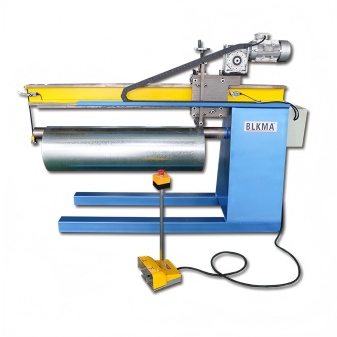
For this production application, the condition of the seam itself deserves more attention than general duct flexibility. The lock seam is a mechanical connection, so its quality depends on the relationship between the formed edges, sheet thickness, closing geometry, and machine adjustment.
One common problem is incomplete seam closure. This can occur when the edges are not correctly formed before entering the closing section, when the material is not positioned properly, or when the closing mechanism is not adjusted to the required profile. Simply increasing closing force may not solve the problem if the incoming geometry is already incorrect.
Another issue is an uneven or distorted seam. This may be related to inconsistent feeding, forming-roll alignment, machine wear, or unsuitable adjustment. If the seam looks acceptable at the beginning of a production run but becomes inconsistent later, the condition of the machine components and the stability of the material path should be checked.
| Lock seam problem | Possible cause | What to check |
|---|---|---|
| Incomplete seam closure | Incorrect edge profile or closing adjustment | Profile dimensions, machine alignment, and closing settings |
| Uneven seam appearance | Inconsistent feeding or forming | Material path, guides, and forming components |
| Deformed area around the seam | Excessive closing force or incorrect positioning | Closing pressure and machine alignment |
| Intermittent seam defects | Material variation or unstable machine operation | Sheet consistency and production stability |
| Difficulty engaging the lock | Incorrect edge geometry | Upstream forming and snap-lock profile |
Where a snap lock duct machine is responsible for forming the connecting profile, the accuracy of that profile should be checked before making major changes to the closing equipment. This approach can prevent manufacturers from compensating for an upstream problem with increasingly aggressive downstream settings.
Different duct constructions and sheet specifications may require different machine settings. Material thickness, duct diameter, edge profile, and seam design can all influence how the forming and closing stages should be configured.
A setting that produces a satisfactory seam on one production specification may not be appropriate for another. When sheet thickness changes, for example, the forming and closing conditions may need to be adjusted to maintain the intended seam geometry without unnecessarily deforming the sheet.
Duct diameter can also affect production conditions. Smaller and larger round ducts may present different forming requirements, so manufacturers should not assume that one setup will provide identical results across the entire product range.
This makes adjustment flexibility an important consideration when selecting a round duct lock seam closing machine. Operators need enough control to adapt the equipment to the intended production range while still being able to reproduce settings that have already been proven effective.
Manufacturers reviewing equipment configurations can explore the BLKMA product range to see how different duct fabrication machines fit into broader HVAC sheet-metal production processes. The most suitable configuration depends on the duct specifications, materials, production volume, and seam requirements of the individual manufacturer.
Consistent lock seam quality is ultimately a process-control issue. A manufacturer may have a capable machine, but if material preparation, forming, feeding, and closing conditions vary significantly, the finished seams will also vary.
A practical way to improve consistency is to treat the forming and closing stages as one connected process. The snap lock duct machine needs to create a repeatable edge profile, while the round duct lock seam closing machine needs to close that profile under stable conditions. When both stages are properly matched, operators have fewer reasons to compensate manually during production.
Routine maintenance also matters. Forming rolls, guides, closing components, and other working parts can gradually change with normal use. Even without a sudden mechanical failure, wear can alter the geometry enough to create recurring seam problems. Periodic inspection and adjustment can help maintain the conditions required for repeatable production.
Quality checks should focus on the finished seam as well as the stages that create it. If a defect is found, identifying where the variation first appeared is generally more useful than simply correcting the final product. This allows manufacturers to address the underlying cause and reduce the likelihood of the same problem recurring.
For manufacturers experiencing recurring lock seam issues or planning a new round duct production line, discussing the actual material specifications, duct sizes, edge profiles, and production conditions with the equipment supplier can provide a more practical basis for machine selection. Companies can contact BLKMA to discuss their specific production requirements and equipment configuration.
Lock seam problems in round duct production are often the result of several connected factors rather than a single machine setting. Material feeding, edge-profile forming, machine alignment, closing conditions, sheet thickness, and equipment wear can all influence the final seam.
A reliable round duct lock seam closing machine can provide consistent closing performance, but it works best when the incoming duct profile is accurately formed and the material reaches the closing section under stable conditions. Likewise, a properly configured snap lock duct machine can help establish the edge geometry needed for a clean and repeatable lock seam.
For manufacturers looking to reduce recurring seam defects, the most useful approach is to examine the complete production sequence rather than adjusting the final closing operation in isolation. Consistent material handling, accurate forming, appropriate machine settings, regular maintenance, and controlled quality checks can together create a more stable round duct production process.
An incomplete seam can result from incorrect edge forming, inaccurate machine alignment, unsuitable closing settings, or inconsistent material positioning.
Uneven feeding, material variation, forming-roll misalignment, machine wear, or changing machine conditions can cause seam consistency problems.
Yes. The edge profile formed before closing directly affects how easily and consistently the lock seam can be engaged.
Not always. The incoming edge profile, material feeding, alignment, and machine condition should also be checked to identify the actual source of the defect.
Yes. Different sheet thicknesses can require different forming and closing conditions to achieve consistent seam engagement without excessive deformation.
Consistent material preparation, accurate edge forming, stable feeding, appropriate machine adjustment, regular maintenance, and routine seam inspection all contribute to stable production.

 Call us on:
  Email us:
  Dongcheng Industrial park, Bowang District of
FREE QUOTE
Dongcheng Industrial park, Bowang District of
FREE QUOTE
 English
 한국어
한국어 Deutsch
 Español
 italiano
 العربية
 Polska
 Svenska
 українська
 Malay
Malay