

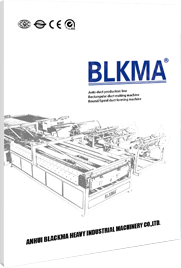
Air duct manufacturers rarely deal with just one standard duct specification. A typical production schedule may involve different duct dimensions, sheet thicknesses, connection methods, and order quantities, often with tight delivery requirements. As the number of specifications increases, maintaining consistent dimensions across every batch becomes more difficult when cutting, forming, and folding depend heavily on manual operations.
This is one of the main reasons manufacturers are investing in modern air duct fabrication machines. By bringing material feeding, positioning, cutting, forming, and folding into a more controlled workflow, automated equipment can reduce unnecessary manual intervention and make production parameters easier to repeat. Instead of treating accuracy as a final inspection issue, manufacturers can build dimensional control into each stage of fabrication.
The effectiveness of a duct machine, however, depends on more than automation alone. CNC control, material positioning, cutting accuracy, forming and folding performance, process synchronization, and routine quality checks all have a role to play. Understanding these factors can help manufacturers improve production consistency and make more informed decisions when selecting air duct fabrication machines for their facilities.
Material handling is the starting point of accurate duct fabrication. Before a sheet can be cut, grooved, formed, or folded, it must reach the processing area in a controlled position. If the material shifts during feeding, even accurately programmed downstream operations may produce components that differ from the intended dimensions.
This becomes more noticeable when manufacturers process large quantities of sheet metal. Manual positioning may require operators to repeatedly measure and align each workpiece. The more often this process is repeated, the more opportunities there are for small positioning differences to occur.
Automated air duct fabrication machines can reduce this dependence on manual positioning by incorporating controlled feeding and locating systems. Servo-driven feeding, for example, can move material according to programmed requirements and maintain a more consistent relationship between the sheet and the processing tools.
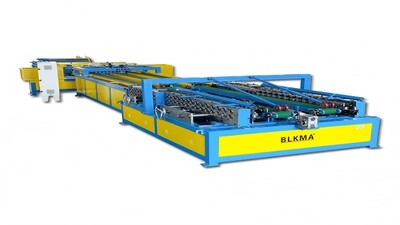
BLKMA's automatic duct production systems use servo feeding and CNC control in their configurations. For example, the company's Auto Duct Production Line 5 lists a servo feeding platform and describes its positioning system as using servo feeding for accurate positioning. ([blkma.com](https://www.blkma.com/products/auto-duct-production-line-5.html?utm_source=chatgpt.com))
However, automated positioning does not remove the need for proper material preparation. Operators should still verify sheet specifications, inspect the material for obvious deformation, and make sure the feeding path is free from obstructions. A duct machine can only maintain repeatable positioning when the material enters the process in a suitable condition.
For manufacturers looking to improve consistency, a useful practice is to inspect the first processed component after loading new material or changing production specifications. This provides an early opportunity to identify positioning problems before they affect a larger batch.
CNC control changes the way duct dimensions are transferred from production requirements to machine operations. Instead of relying entirely on operators to measure, calculate, and manually reproduce each processing dimension, a CNC-controlled system can use programmed data to coordinate different machine functions.
This is particularly useful for manufacturers producing ducts with different dimensions throughout the day. A production line may need to switch between several orders, and each order can require different cutting, forming, and folding parameters. Digital control makes these changes more structured and repeatable.
BLKMA's automatic duct production lines are designed around CNC-controlled processing. The company describes its automatic CNC control system as supporting accurate and consistent processing, while its production-line configurations integrate several duct fabrication processes into a coordinated workflow. ([blkma.com](https://www.blkma.com/products/auto-duct-production-line/?utm_source=chatgpt.com))
The main benefit of CNC control is repeatability rather than simply automation for its own sake. Once production data has been correctly entered, the machine can reproduce the defined processing sequence without requiring the operator to manually recreate every dimension.
There is still an important distinction between CNC control and quality assurance. CNC systems follow the information they receive, so incorrect production data, unsuitable tooling, or poor machine calibration can still result in inaccurate components. For this reason, CNC should be combined with proper setup procedures and regular inspection.
When evaluating a duct machine, manufacturers should therefore consider not only whether CNC control is available, but also how it interacts with feeding, cutting, forming, folding, and production-data management.
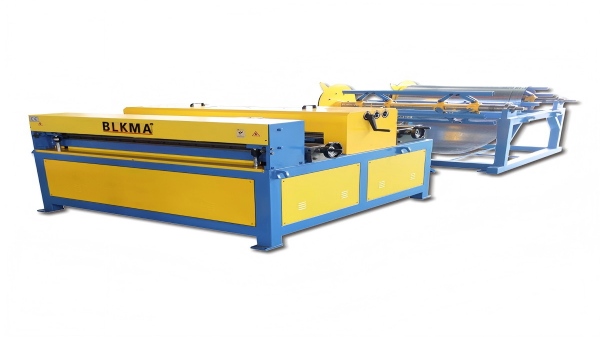
Cutting establishes the basic dimensions of many air duct components. If a panel is not cut according to the required length, width, or notch position, later forming operations cannot fully correct the original error.
For low-volume work, manual measurement and cutting may be practical. As order volume and product variation increase, however, maintaining the same level of repeatability through manual operations becomes more challenging. Automated cutting allows the production system to use defined dimensions and coordinate material positioning with the cutting operation.
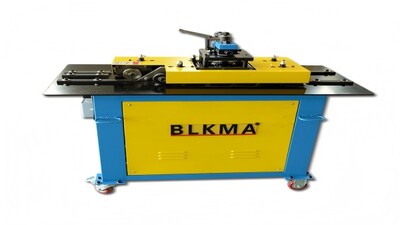
Modern air duct fabrication machines can also combine cutting with other fabrication functions. BLKMA's automatic duct production lines are designed to integrate processes such as leveling, beading or grooving, angle shearing, cutting, Pittsburgh lock forming, TDF flange forming, and folding, depending on the specific line configuration. ([blkma.com](https://www.blkma.com/products/auto-duct-production-line/?utm_source=chatgpt.com))
Process integration is important because cutting does not happen in isolation. The position of a cut can determine where a later fold or connection feature will be located. When material is repeatedly transferred between separate machines, every manual repositioning step introduces another opportunity for dimensional variation.
By coordinating several operations in one production flow, an automated duct machine can reduce unnecessary handling and make the relationship between cutting and downstream forming easier to control.
Manufacturers should nevertheless evaluate cutting performance in the context of their actual products. Important considerations include the materials being processed, required component dimensions, production volume, cutting method, and how easily the cutting process can be integrated with subsequent operations.
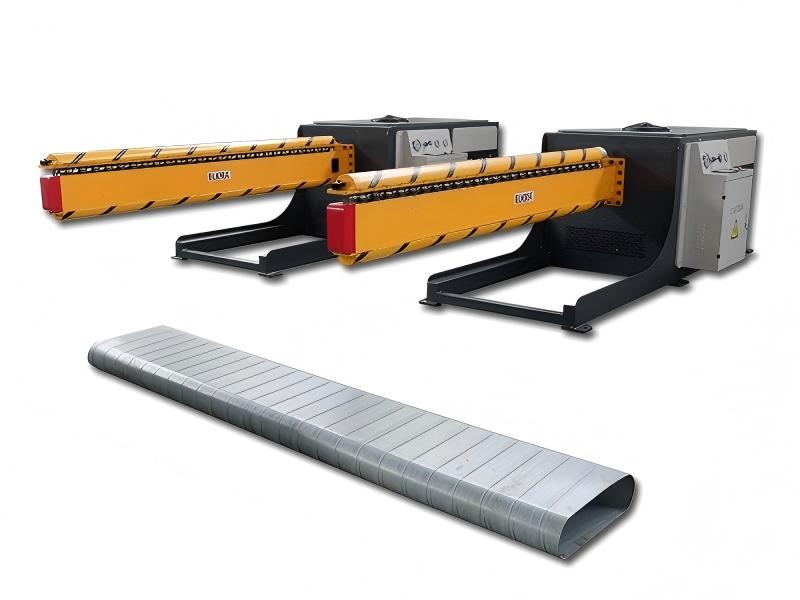
Once a duct panel has been cut, forming and folding determine how accurately it takes its final shape. This stage is particularly important for features such as duct edges, locks, flanges, and connection points.
A panel can have correct basic dimensions but still cause assembly problems if a fold is positioned incorrectly. Even relatively small differences in folding position can affect how two components meet during installation. Inconsistent forming may also require workers to make manual corrections before assembly.
This is why forming and folding should be considered part of the same accuracy chain as feeding and cutting. Each operation needs to preserve the dimensional relationships established by the previous operation.
BLKMA's Auto Duct Production Line 5 combines several fabrication processes, including leveling, beading, angle shearing, cutting, Pittsburgh lock forming, TDF flange forming, and folding. The published configuration also includes a hydraulic folding machine and servo feeding platform. ([blkma.com](https://www.blkma.com/products/auto-duct-production-line-5.html?utm_source=chatgpt.com))
For manufacturers, this type of integration can reduce the amount of manual transfer between separate fabrication stages. It can also make the production sequence easier to standardize, especially when multiple operators work on the same production line.
The appropriate forming and folding configuration still depends on the duct construction method and application. Manufacturers should consider sheet thickness, duct dimensions, connection system, production volume, and required level of automation before selecting a particular machine configuration.
Automation becomes most useful when several production operations need to work together. Feeding, leveling, beading, notching, cutting, forming, and folding each perform a different task, but they are connected through the movement and positioning of the same sheet metal.
If these operations are poorly coordinated, operators may need to stop the process, reposition material, check dimensions, or make manual corrections. This interrupts production and can create differences between batches.
Process synchronization addresses this issue by coordinating different machine functions according to a defined production sequence. Instead of treating each operation as a separate task, an integrated line can move the material through multiple stages with less manual intervention.
BLKMA offers several automatic duct production line configurations. Its product range includes Auto Duct Production Lines 2, 3, 4, and 5, with different combinations of fabrication functions. For example, Line 3 integrates processes including leveling, grooving or beading, angle shearing, cutting, and folding under an automatic CNC system, while Line 5 adds further forming and folding capabilities. ([blkma.com](https://www.blkma.com/products/auto-duct-production-line/?utm_source=chatgpt.com))
This type of configuration allows manufacturers to select an automation level according to their production requirements. A smaller fabrication operation may prioritize essential automated functions, while a high-volume manufacturer may benefit from a more comprehensive production line.
Automation also helps reduce manual material handling. Every manual transfer creates a possibility of incorrect measurement or positioning. Keeping more operations within a coordinated process can make production easier to repeat and monitor.
Automation improves repeatability, but it does not eliminate quality control. Even advanced air duct fabrication machines require correct material specifications, suitable machine settings, proper tooling, and routine maintenance.
A practical quality-control procedure can include several checkpoints:
Material verification: Confirm the material type, thickness, and dimensions before production.
Feeding inspection: Check that the sheet enters the machine correctly and that the feeding path is unobstructed.
First-piece inspection: Measure the first component after a new setup or major specification change.
Dimensional checks: Verify critical component dimensions against the production drawing or order requirements.
Forming inspection: Check locks, flanges, grooves, and folds for correct position and shape.
Process monitoring: Periodically inspect production output during longer runs.
Machine maintenance: Check cutting tools, guides, rollers, sensors, and other components according to the equipment manufacturer's requirements.
First-piece inspection is especially useful when production switches from one duct specification to another. Rather than waiting until a complete batch has been processed, operators can identify an incorrect setting at the beginning of the run.
Manufacturers can also maintain records of commonly used production parameters. When a particular duct configuration is produced repeatedly, previous successful settings can provide a useful starting point for the next production run.
This approach demonstrates why the performance of a duct machine should not be judged solely by processing speed. Ease of setup, control functions, machine stability, maintenance requirements, and technical support can all influence the consistency achieved in daily production.
BLKMA has specialized in duct forming machinery since 1994. The company states that its equipment and services have reached customers in more than 100 countries, and its current product portfolio includes automatic duct production lines, rectangular duct making machines, spiral duct machines, and round duct making machines. ([blkma.com](https://www.blkma.com/about-us.html?utm_source=chatgpt.com))
The choice between manual processing and automated air duct fabrication machines depends on production requirements. The following comparison highlights where automation can contribute to accuracy and consistency.
| Production Factor | Manual or Semi-Manual Processing | Automated Duct Fabrication |
|---|---|---|
| Material Positioning | More dependent on operator measurement and handling | Can use controlled feeding and positioning systems |
| Dimension Management | Dimensions may need to be transferred manually between operations | CNC systems can use programmed production data |
| Cutting | Often requires separate measurement and cutting steps | Can be integrated into a coordinated production sequence |
| Forming and Folding | May require manual transfer between machines | Multiple operations can be integrated into one line |
| Repeatability | More affected by operator-to-operator differences | More dependent on standardized machine settings |
| Material Handling | More manual movement between processes | Can reduce unnecessary handling within the production line |
| Production Control | Greater reliance on manual coordination | Centralized control can coordinate multiple machine functions |
Automation is not automatically the right solution for every facility. Manufacturers should consider production volume, product variety, labor requirements, available floor space, investment budget, and the type of duct being produced before selecting equipment.
Accurate air duct fabrication depends on consistency throughout the entire production process. Material feeding and positioning establish the starting point, CNC control helps reproduce programmed dimensions, precision cutting creates correctly sized components, and forming and folding determine how accurately those components take their final shape.
Automation becomes even more valuable when these operations are synchronized. By reducing unnecessary manual handling and coordinating multiple fabrication stages, modern air duct fabrication machines can provide a more repeatable production workflow.
For manufacturers comparing different equipment options, the right duct machine should therefore be evaluated as part of the complete production system rather than by a single specification. Feeding accuracy, CNC control, cutting, forming, folding, process integration, maintenance, and technical support all deserve consideration.
BLKMA has specialized in duct forming machinery since 1994 and offers equipment covering automatic duct production and other duct fabrication requirements. Manufacturers can review the company's available equipment on the BLKMA Products page. For specific questions about machine configuration, material compatibility, or production requirements, manufacturers can contact BLKMA directly.
They can control material feeding, positioning, cutting, forming, and folding more consistently, reducing variation caused by repeated manual operations.
CNC control allows programmed production data to coordinate machine operations, making repeated dimensions and processing sequences easier to reproduce.
Incorrect positioning can shift cutting, forming, or folding locations. Stable material positioning provides a more reliable starting point for downstream operations.
Cutting establishes the basic dimensions and feature positions of duct components. Errors at this stage can affect subsequent forming and assembly.
Many automated systems can process different specifications within their designed operating range. The actual capability depends on the machine configuration, material, and production requirements.
Consider material compatibility, processing dimensions, feeding and positioning, CNC control, cutting, forming and folding functions, automation level, maintenance, and technical support.

 Call us on:
  Email us:
  Dongcheng Industrial park, Bowang District of
FREE QUOTE
Dongcheng Industrial park, Bowang District of
FREE QUOTE
 English
 한국어
한국어 Deutsch
 Español
 italiano
 العربية
 Polska
 Svenska
 українська
 Malay
Malay