

Producing spiral ducts at scale is not simply a matter of forming metal into a round shape. Every stage of the process, from feeding the coil to forming the spiral seam and cutting the finished duct, can influence the final dimensions and overall consistency. When these stages are not properly coordinated, manufacturers may see variations in duct diameter, uneven forming, inaccurate lengths, or repeated machine adjustments during production.
For this reason, the performance of a spiral duct machine should be evaluated by more than its forming speed or maximum duct diameter. The way the machine handles material alignment, roller adjustment, size changes, and automatic cutting can have a direct impact on production stability. A machine that maintains consistent forming conditions can help reduce rework while making it easier to produce different duct specifications on the same production line.
Understanding what affects forming accuracy is particularly important when selecting equipment from different spiral duct machine manufacturers. By looking closely at material feeding, forming rollers, machine settings, cutting precision, and calibration, manufacturers can identify where production consistency comes from and how to improve it in daily operation.
Duct forming accuracy is determined by the interaction of several parts of the production process. The machine structure provides the foundation, but the way material enters the machine and how the forming system is adjusted can be just as important.
The first consideration is material stability. A coil that does not feed smoothly can introduce variations before the material even reaches the forming section. Alignment is another critical factor because the strip needs to follow a controlled path throughout the forming process. If its position changes during production, the final duct may not maintain the intended geometry.
The condition and adjustment of forming components also matter. Rollers need to maintain consistent contact with the material, while the selected settings should correspond to the target duct diameter and material thickness. Cutting is part of the same process. Even when the duct itself is formed accurately, poor cutting synchronization can result in finished pieces that do not meet the required length.
A useful way to look at forming accuracy is therefore as a complete production chain:
Coil feeding establishes stable material movement.
Guides maintain material alignment.
Forming components establish the duct diameter and spiral shape.
Machine settings adapt the process to different specifications.
Automatic cutting determines finished duct length.
Inspection and calibration maintain repeatability over time.
When comparing a spiral duct machine, manufacturers should evaluate these functions together rather than focusing on one headline specification.
The forming process starts before the material reaches the forming rollers. The coil feeding system needs to deliver the strip steadily while keeping it correctly positioned. If the strip moves laterally, experiences unstable tension, or enters the forming section at an inconsistent angle, the forming process can become harder to control.
This is particularly important in continuous production. A minor alignment problem at the beginning of a short test run may become a larger dimensional issue over a longer production cycle. Operators should therefore check the coil position and feeding path before production begins and confirm that the material is entering the machine smoothly.
Material quality should also be considered. Differences in thickness, surface condition, or material properties can affect how the strip responds to forming. The machine should be operated within the material range specified for its particular configuration rather than assuming that every type of sheet or strip will behave in exactly the same way.
For spiral duct machine manufacturers, the feeding and guiding structure is therefore an important part of overall machine design. A well-controlled feeding path reduces unnecessary manual correction and makes the forming process more repeatable from batch to batch.
In practical production, one of the simplest quality-control steps is to inspect the first formed section after coil loading or a major setup change. Checking the duct diameter, spiral seam, and general appearance at this stage allows operators to identify alignment issues before a large quantity of material is processed.
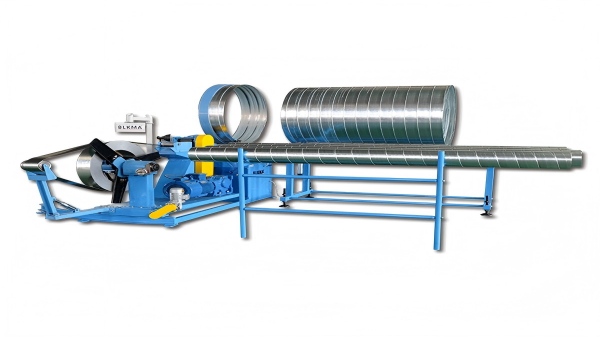
Forming rollers play a central role in converting the flat metal strip into a spiral duct. Their position determines how the material is guided and shaped, which means roller adjustment has a direct relationship with dimensional consistency.
If the forming components are not correctly positioned, the duct may gradually deviate from the intended diameter. Excessive wear, contamination, looseness, or an unsuitable setup can also affect the contact between the material and the forming system.
For this reason, roller inspection should be part of normal machine maintenance. Operators do not necessarily need to make frequent adjustments; the more important objective is to ensure that the forming components remain in known and repeatable working conditions.
BLKMA's spiral duct forming machines use a duct-mold forming principle. The company's published information states that this configuration is designed to form round spiral ducts with accurate diameters and can produce different duct diameters and lengths according to production requirements.
When evaluating different spiral duct machine manufacturers, buyers should therefore look beyond maximum diameter and speed. The forming structure, adjustment method, suitability for different material thicknesses, and ease of maintaining consistent settings are all relevant to long-term production performance.
One machine may be required to produce several duct specifications during the same working week. In that situation, simply using one set of parameters for every product is unlikely to provide the best results. Machine settings need to correspond to the required diameter, material thickness, and production conditions.
Duct diameter is particularly important because it can influence forming speed and machine load. BLKMA's published technical information notes that smaller spiral duct diameters can generally be produced at higher speeds, while larger diameters require slower production because the machine experiences greater load.
The manufacturer's current product page lists the BAL-1500 with a diameter range of 100–1500 mm, a material thickness range of 0.5–1.2 mm, and a feeding speed of 0–35 m/min. The BAL-1500C is listed with a diameter range of 80–1500 mm, a material thickness range of 0.4–1.2 mm, and a feeding speed of 1–45 m/min. These figures apply to the respective models and should not be treated as universal specifications for every spiral duct machine.
When changing from one duct specification to another, a controlled setup procedure can make production more predictable:
Confirm the required duct diameter and material thickness.
Check that the machine configuration supports the selected material and dimensions.
Adjust the forming setup according to the machine's operating requirements.
Run an initial section at an appropriate production speed.
Inspect the diameter, seam condition, and overall forming quality.
Record successful settings for repeat production where appropriate.
The purpose of this approach is not to eliminate operator involvement. Instead, it creates a repeatable method that reduces unnecessary trial and error when production specifications change.
Accurate forming is only part of the finished-product requirement. Once the duct reaches the required diameter, it must also be cut to the specified length. A cutting process that is poorly synchronized with forming can create unnecessary variation even when the duct itself has been formed correctly.
Length accuracy is important for downstream installation and fabrication. If finished sections are consistently too long, additional trimming may be required. If they are too short, the pieces may no longer meet the intended application requirements.
For continuous spiral duct production, synchronized automatic cutting can make the overall process more efficient. BLKMA's published specifications describe a high-speed synchronous automatic cutting system for cutting ducts according to the required length. Its product information also describes the cutting method as low-noise cold shearing.
Cutting quality should therefore be evaluated together with forming performance. Buyers comparing a spiral duct machine should consider whether the forming and cutting stages work as a coordinated production system instead of evaluating the cutting function in isolation.
After cutting, quality checks can include duct length, diameter, seam appearance, and general structural condition. The exact inspection criteria will depend on the manufacturer's specifications and the requirements of the finished duct application.
Even a well-designed spiral duct machine needs a consistent operating procedure. Normal mechanical wear, changes in material, different operators, and repeated size changes can gradually introduce variation into production. Calibration and process monitoring help keep these variables under control.
A practical process-control routine can include:
Checking coil position before each new production run.
Confirming material thickness against the planned specification.
Inspecting forming rollers and related components.
Verifying machine settings after changing duct dimensions.
Checking the first finished duct after setup.
Monitoring dimensions periodically during longer production runs.
Recording recurring adjustment requirements.
Recording production settings can be especially useful when the same duct size is produced repeatedly. Instead of starting from an unknown setup every time, operators can refer to previous successful production conditions and then make minor adjustments where necessary.
This approach also highlights why technical support matters when selecting among spiral duct machine manufacturers. Machine installation, commissioning, operator training, troubleshooting, and maintenance support can all influence how effectively equipment performs after installation.
BLKMA states that it has specialized in duct forming machinery since 1994 and provides overseas services including installation, commissioning, training, and maintenance. The company also states that its duct-processing equipment has been supplied to customers in more than 100 countries.
For a production facility, this type of support can be particularly useful during initial commissioning and when introducing new duct specifications. The goal is to establish a stable production process rather than simply install a machine and leave operators to determine all settings independently.
Machine selection should be based on the actual production requirements rather than one isolated performance number. The following comparison framework can help buyers assess different equipment options more systematically.
| Factor | Why It Matters | What to Check |
|---|---|---|
| Duct Diameter Range | Determines which duct sizes can be produced | Compare the machine range with current and planned product specifications |
| Material Thickness Range | Determines material compatibility | Confirm the machine's specified thickness range |
| Coil Feeding | Influences material stability before forming | Check feeding control and material-guiding arrangements |
| Forming System | Directly influences duct dimensions and forming quality | Review forming structure, adjustment, and maintenance requirements |
| Cutting System | Determines finished duct length consistency | Check cutting synchronization and cutting method |
| Speed Range | Affects production capacity for different duct specifications | Check rated speed for the actual duct sizes and materials required |
| Technical Support | Helps maintain equipment performance after installation | Ask about installation, commissioning, training, spare parts, and service |
For example, BLKMA publishes model-specific specifications for its BAL-1500 and BAL-1500C machines rather than presenting one universal specification for its entire spiral duct machine range. This is an important distinction when comparing suppliers: the relevant question is not simply whether a manufacturer offers a certain capability, but whether the specific model and configuration match the intended production requirements.
Improving spiral duct forming accuracy is a process-control challenge as much as a machine-selection decision. Stable coil feeding, accurate material alignment, properly maintained forming rollers, suitable settings, synchronized cutting, and regular calibration all contribute to consistent finished ducts.
For manufacturers producing multiple duct sizes, establishing a repeatable setup and inspection procedure can be just as valuable as choosing a machine with a broad operating range. It reduces unnecessary adjustments and makes production results easier to reproduce across different batches.
When comparing spiral duct machine manufacturers, buyers should therefore consider the complete production system: machine configuration, forming method, material compatibility, cutting performance, control requirements, and technical support. BLKMA has specialized in duct-forming machinery since 1994 and offers spiral duct forming machines alongside other equipment for round and rectangular duct production.
To explore BLKMA's range of duct manufacturing equipment, visit the BLKMA Products page. If you need help matching a spiral duct machine with your required duct diameter, material thickness, or production workflow, you can contact BLKMA for further information.
There is no single factor. Material alignment, feeding stability, forming roller adjustment, machine settings, material thickness, and calibration all contribute to forming accuracy.
Proper alignment keeps the metal strip on a stable forming path and helps maintain consistent duct dimensions and spiral seam quality.
Yes. Duct diameter and material thickness can affect forming conditions and production speed, so settings should be matched to the specific production requirement.
The rollers guide and shape the material during forming. Incorrect positioning, wear, or unsuitable adjustment can contribute to dimensional variation.
Synchronized cutting helps produce duct sections with the required length while maintaining a continuous production workflow and reducing manual trimming.
Compare the specific machine's diameter and thickness ranges, forming structure, feeding system, cutting method, production speed, maintenance requirements, technical support, and suitability for your actual production needs.

 Call us on:
  Email us:
  Dongcheng Industrial park, Bowang District of
FREE QUOTE
Dongcheng Industrial park, Bowang District of
FREE QUOTE
 English
 한국어
한국어 Deutsch
 Español
 italiano
 العربية
 Polska
 Svenska
 українська
 Malay
Malay