

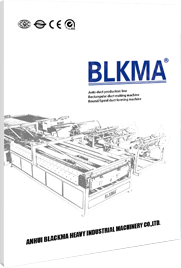
In the competitive landscape of HVAC industrial fabrication, structural integrity and air containment are paramount. When engineering mechanical air distribution networks for demanding environments—such as commercial kitchen exhaust systems, laboratory cleanrooms, chemical transport facilities, and high-pressure industrial ventilation—traditional sheet metal mechanical joints often fall short. Standard lock-seaming methods can leave minuscule gaps that compromise airtightness, leading to static pressure loss and energy inefficiencies.
To overcome these structural limitations, modern manufacturing facilities have transitioned from mechanical overlapping seams to automated resistance melt-welding. The cornerstone of this high-efficiency transition is the specialized stitch welding machine. By replacing manual labor-intensive welding processes with a synchronized, high-speed automated system, this machine allows manufacturers to achieve perfectly sealed, high-strength longitudinal seams on round ventilation pipes.
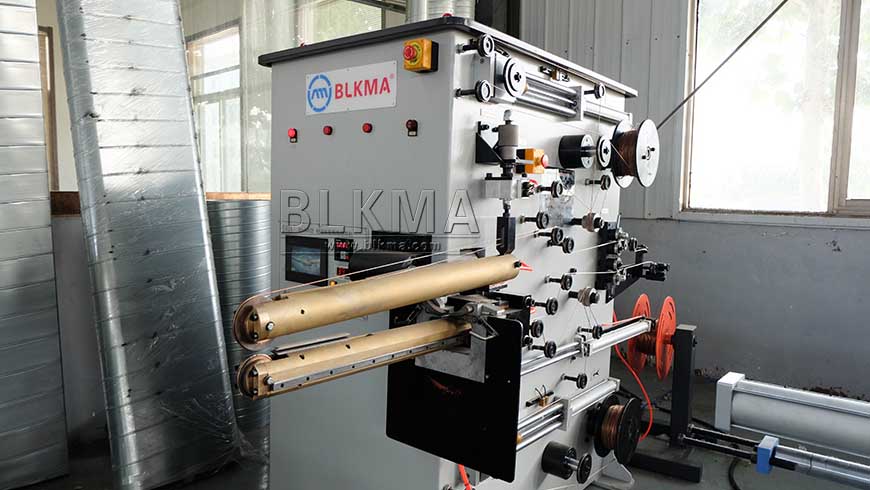
The round duct stitch welding machine (often referred to in the sheet metal industry as a longitudinal seam resistance welder) operates as an automated system designed to permanently fuse the vertical overlapping edges of pre-rolled metal cylinders. Rather than relying on external filler metals or traditional manual arc welding setups, this equipment utilizes localized electrical resistance to create a molecular bond.
The automated process begins when an operator slides a pre-rolled metal sheet over the machine's lower welding arm. Integrated mechanical guides instantly clamp and align the overlapping vertical edges to prevent material shifting. A set of upper and lower copper alloy rolling wheel electrodes then applies highly calibrated pneumatic or hydraulic pressure directly to the joint. As these motorized wheels roll steadily along the seam, they pass a high-amperage electrical current through the metal. The material's natural resistance generates concentrated thermal energy, instantly melting and forging the overlapping layers into a continuous, unbroken weld seam.
For production managers evaluating workshop performance, integrating an industrial stitch welder delivers measurable mechanical and financial advantages that mechanical joints simply cannot match.
Absolute Leak Proofing: Traditional mechanical lock seams rely on physical folding, which can slowly loosen or deflect under continuous high-velocity fan vibrations. An industrial stitch welder creates a homogeneous, fused metal bond. This ensures 100% airtight performance, satisfying strict Class C and Class D duct leakage specifications.
Maximizing Sheet Utilization: Traditional mechanical overlapping joints or flange connectors require substantial material allowances (often up to 10 mm to 15 mm of extra sheet width) to execute a physical fold. In contrast, resistance seam welding requires a minimal overlap of only a few millimeters, saving an enormous volume of steel coil inventory over large production runs.
Unmatched Structural Rigidity: Because the welded joint is physically as strong as the parent sheet metal, the finished round duct can withstand massive positive or negative internal static pressures without the risk of seam blowout.
Elimination of Post-Weld Grinding: Traditional manual welding methods leave behind thick slag, spatter, and severe thermal distortion. The localized heat concentration of an automated stitch welding machine leaves an ultra-thin, smooth aesthetic profile that requires zero post-production scraping.
In a high-output fabrication facility, the stitch welding machine acts as the high-speed bridge between initial sheet forming and final component installation. To achieve a seamless manufacturing velocity, the equipment integrates directly with standard sheet metal prep and finishing units.
The production sequence begins with raw galvanized steel or stainless steel sheets being cut to size and passed through an electric rolling machine to form a uniform, open-seamed cylinder. This open tube is immediately transferred to the welding station, where the industrial stitch welder locks and seals the longitudinal seam at a steady linear velocity, instantly transforming the flexible sheet into a rigid structural pipe. Once the vertical seam is sealed, the pipe is moved to a flange rolling machine or an end-grooving machine. These finishing units roll an integrated flange or connection collar directly onto the duct ends, enabling rapid, secure, and airtight interlocking assembly on the construction job site.
Engineered for continuous heavy-duty workshop cycles, the BLKMA vertical seam welding solution integrates advanced electronic control with heavy structural mass to ensure flawless output consistency.
The system features a centralized control panel that allows operators to store custom configurations for various material types. Whether welding thin 0.4 mm galvanized iron or thick 1.0 mm stainless steel sheets, the programmable system automatically calibrates welding speed, current frequency, and electrode clamping pressure. Furthermore, because welding galvanized steel can be difficult due to zinc vaporization fouling traditional copper wheels, the machine incorporates a specialized copper wire interlayer system. This continuous wire feed prevents zinc contamination, guaranteeing a stable arc and uniform weld penetration without damaging the surrounding protective zinc coating. Driven by a high-torque motorized system, the wheel electrodes maintain a steady pace across the full length of the tube, eliminating uneven burning or cold-weld weak points.
Choosing manufacturing hardware is a long-term investment that requires a partner with proven technical authority. Founded in 1994 in Ma'anshan, Anhui Province, China, BLKMA has spent decades setting benchmarks in the pipeline processing machinery sector, actively participating in the creation of national Chinese pipeline machinery industry standards.
Our modern manufacturing facility is strategically located just 26 kilometers from Nanjing Lukou International Airport, providing a highly accessible location for international procurement teams to conduct live machinery audits. By managing all core tooling fabrication and mechanical assembly completely in-house, BLKMA ensures strict quality control and total component compatibility across your entire assembly line. This dedicated manufacturing focus guarantees that your automated stitch welding machine will deliver stable processing performance, minimal downtime, and long-term operational reliability.
Upgrading to an automated stitch welding machine is an essential step for fabrication facilities aiming to secure high-specification industrial HVAC contracts. By combining material-saving overlapping paths with high-speed resistance welding wheels, an industrial stitch welder delivers structural strength and absolute airtight sealing that manual operations cannot match. Partnering with BLKMA provides your facility with standard-setting engineering precision, enabling your workforce to output premium, leak-free round duct networks with low maintenance overhead and maximum operational efficiency.

 Call us on:
  Email us:
  Dongcheng Industrial park, Bowang District of
FREE QUOTE
Dongcheng Industrial park, Bowang District of
FREE QUOTE
 English
 한국어
한국어 Deutsch
 Español
 italiano
 العربية
 Polska
 Svenska
 українська
 Malay
Malay