

In modern architectural design, mechanical contractors face a constant challenge: delivering high-volume airflow through increasingly tight, low-clearance structural spaces. Traditional round pipes are highly efficient but require significant vertical space. Rectangular ducts fit tighter gaps but suffer from air leakage and pressure loss. The solution that bridges this gap is the flat-oval duct, manufactured efficiently using a specialized oval duct machine.
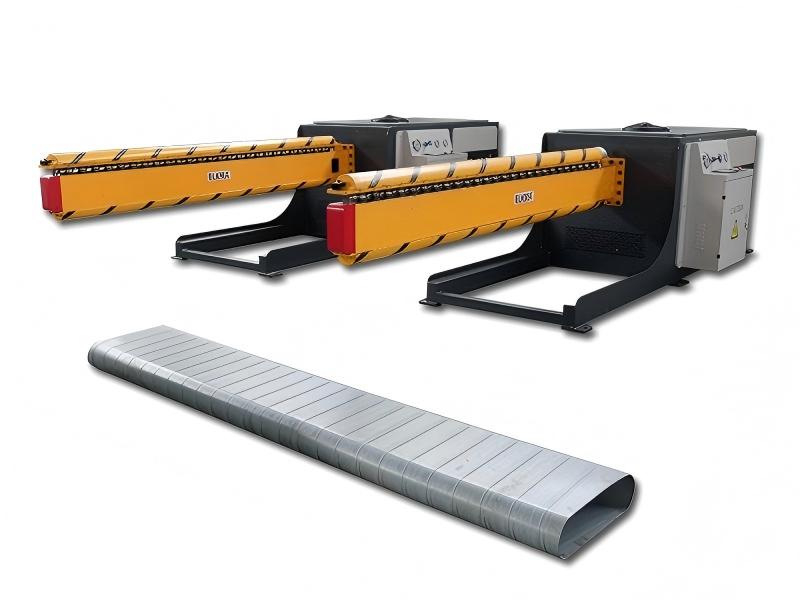
The oval duct machine is a specialized piece of HVAC sheet metal machinery designed to transform standard round spiral ducts into low-profile, flat-oval configurations. It does not form the duct directly from a raw steel coil; instead, it utilizes a precise, two-step fabrication process.
Feeding: A pre-formed round spiral pipe (smooth or corrugated) is loaded onto the machine's long working chassis.
Internal Expansion: A set of modular, heavy-duty expansion mandrels (or core dies) enters the inside of the round tube. Driven by high-torque hydraulic power, these mandrels expand radially, stretching the metal outward.
External Shaping: Simultaneously, external forming trays compress the sides of the duct. This coordinated internal pushing and external pressing smoothly reshapes the tube.
Final Profile: The resulting duct features flat top and bottom surfaces bounded by perfectly rounded, semicircular sides—maintaining its structural lock seams without any ruptures or loss of airtightness.
For HVAC manufacturing factories and commercial contractors, investing in an oval duct machine is a strategic necessity driven by real-world architectural demands and engineering advantages.
Exceptional Space Optimization: In buildings with low ceiling clearances—such as modern high-rise offices, commercial malls, and underground parking structures—traditional round ducts simply will not fit. Flat-oval ducts reduce the vertical footprint while maintaining the large cross-sectional area needed for high-volume airflow.
Superior Aerodynamics Over Rectangular Ducts: Unlike rectangular ducts, flat-oval pipes have no sharp 90-degree corners. This eliminates air turbulence, minimizes pressure drops, and significantly reduces the energy consumption of the building's fan systems.
Reduced Noise and Rumble: Rectangular duct walls tend to vibrate or "rumble" under high air velocities. The curved semicircular sides of a flat-oval duct naturally distribute pressure, ensuring quiet operation in luxury commercial spaces.
Material and Labor Savings: Flat-oval systems require fewer joints, less sealing compound, and lighter hanger supports compared to heavy rectangular duct networks, reducing overall installation costs.
The oval duct machine does not operate in isolation. In a professional HVAC fabrication facility, it serves as the critical final shaping hub within a fully automated, multi-stage production sequence.
Stage 1 (Tube Forming): High-speed spiral duct machine units continuously convert galvanized or stainless steel coils into standard round spiral tubes.
Stage 2 (Sizing and Cutting): Automatic plasma cutting systems or synchronized flying shears cut the round tubes to the precise lengths required for the project.
Stage 3 (Oval Transformation): The heavy-duty oval duct machine takes these standard sections and reshapes them into the low-profile flat-oval geometry.
Stage 4 (Component Matching): Auxiliary equipment, including specialized elbow making machine lines and angle steel flange rolling machines, fabricate the corresponding oval elbows, offsets, and connectors to complete the entire airtight network.
The BLKMA spiral round flat-oval configuration machine is engineered to deliver high precision, long-term structural reliability, and effortless operation.
Smart PLC and LCD Control System: The machine's behavior is governed by an advanced programmable logic controller (PLC) paired with an intuitive LCD touchscreen panel. Operators can easily input, save, and recall precise forming parameters—such as hydraulic pressure and expansion stroke lengths—reducing specifications changeover times to mere minutes.
Broad Processing Range and Versatility: The machine accommodates input round diameters ranging from 450 mm to 1500 mm (18" to 60") and can process standard duct lengths up to 3000 mm. It effortlessly handles material thicknesses from 0.4 mm to 1.2 mm.
Comprehensive Die and Tray Configurations: Equipped with a wide range of standard die specifications (Φ150 to Φ500 mm) and adjustable tray configurations (50 mm to 600 mm), it allows factories to produce a vast portfolio of flat-oval dimensions with a single machine.
Robust, Heavy-Duty Chassis: Weighing 2200 kg and driven by a powerful 7.5 KW main motor, the physical frame provides the massive rigid stability required to absorb immense torsional forces during the metal-stretching cycle. This prevents machine vibration and ensures the finished ducts remain perfectly straight over their full 3-meter length.
Choosing manufacturing equipment is about more than just comparing technical data sheets; it is about securing a reliable, long-term partnership with an industry authority.
Founded in 1994 in Ma'anshan, Anhui Province, China, BLKMA has spent decades cementing its position as a premier modern enterprise in the pipeline processing machinery sector. As a trusted leader whose technical expertise is integrated into China's national pipeline machinery industry standards, BLKMA combines deep engineering heritage with continuous technological innovation.
Our manufacturing facility is strategically located just 26 kilometers from Nanjing Lukou International Airport, supported by a highly developed transportation infrastructure that allows global procurement managers and technical engineers to visit our production lines at any time. By manufacturing all core machinery and tooling completely in-house, BLKMA guarantees strict quality control and seamless system compatibility. This ensures your primary spiral tube formers, cutting systems, and oval duct machine units integrate flawlessly with zero operational bottlenecks. Partnering with BLKMA means securing stable processing performance, lower maintenance overheads, and maximum long-term production uptime for your fabrication facility.
The machine easily processes both galvanized iron and stainless steel within its specified thickness envelope of 0.4 mm to 1.2 mm. Because stainless steel possesses a higher tensile yield strength, operators can simply adjust the hydraulic pressure settings via the LCD panel to compensate for the material's spring-back tendencies.
Digital parameter adjustments on the PLC touchscreen take less than a minute. A physical swap out of the heavy-duty shaping dies and modular expansion trays typically takes between 15 to 30 minutes, depending on the operator's experience.
No. The expansion mandrels apply radial force smoothly and uniformly along the inner circumference. This controlled hydraulic movement stretches the metal without scratching the protective zinc layer or degrading the structural integrity of the interlocking airtight seams.

 Call us on:
  Email us:
  Dongcheng Industrial park, Bowang District of
FREE QUOTE
Dongcheng Industrial park, Bowang District of
FREE QUOTE
 English
 한국어
한국어 Deutsch
 Español
 italiano
 العربية
 Polska
 Svenska
 українська
 Malay
Malay